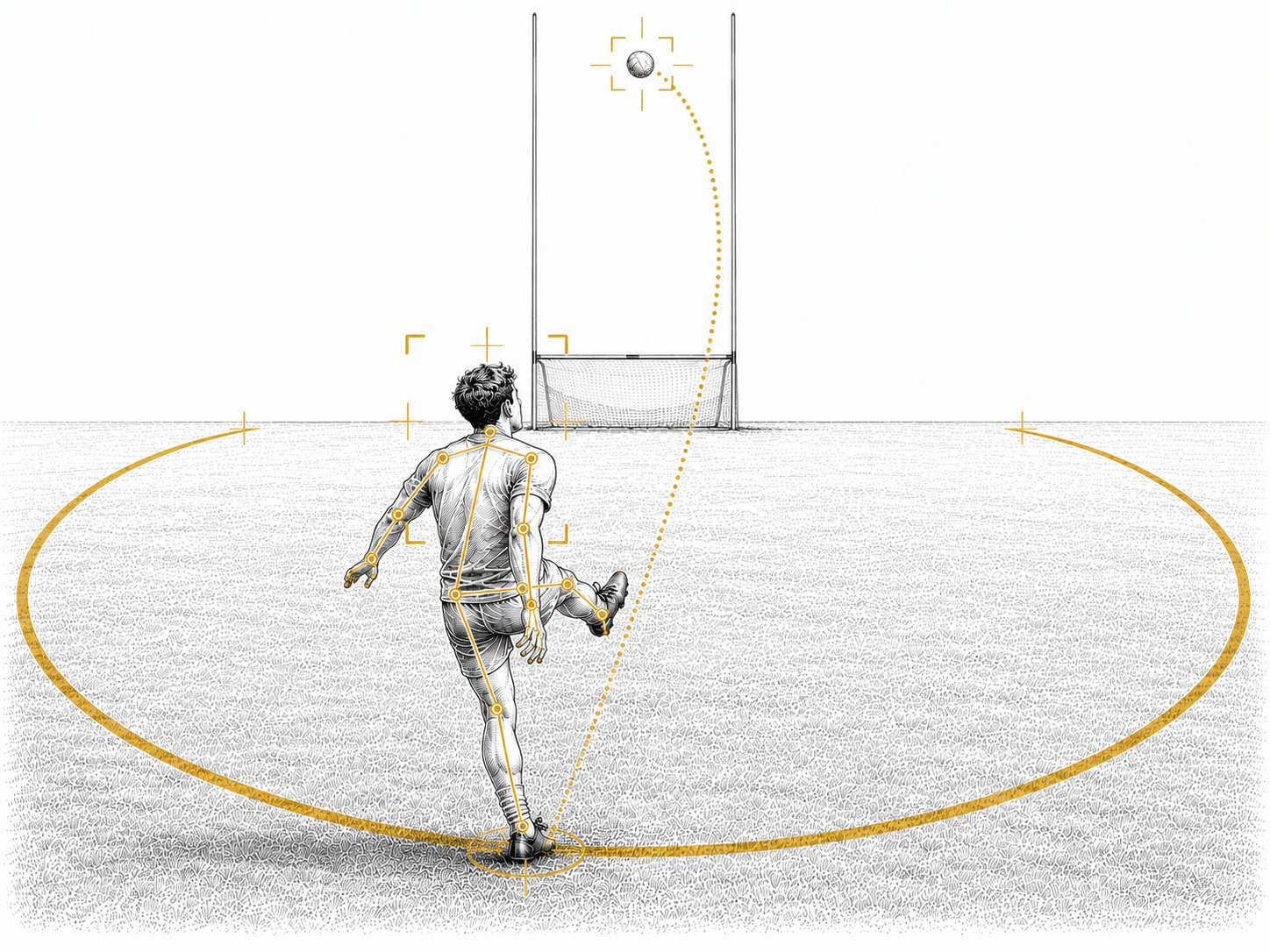
Kerry won the 2025 League and All-Ireland double on the trial rules. The eye test said they did it with the arc: David Clifford and Seán O'Shea kicking long scores. The eye test is half right. Kerry did slot five two-pointers in the final, three from Clifford. But the counties that leaned on the arc most were not Kerry. They were Monaghan and Meath. Neither lifted Sam.
The arc did shake up the order. It gave counties who had been treading water a real go at the summer, and Monaghan and Meath took it. What it did not do was reward sheer volume. The sides that went deepest kicked best from distance, not most. This is a story about shot selection. And the numbers to tell it are already out there, in the GAA's own Games Intelligence Unit.
What one rule did to a season
From zero to a thousand-plus scores
Before 2025 there was no such thing as a two-point score. In one season the arc produced 1,012 of them across 214 games. And 73% came from open play, not frees. This was not a free-taking gimmick. It was long-range kicking returning as a real skill. The rest of the FRC season audit says the same.
The 2025 reset · measured from match data
One rule, a whole season louder
Six measured changes under the trial rules. The two-pointer is the one that didn't exist before.
Plenty of two-pointers got you a run at the summer. The right ones won Sam.
Who actually relied on the arc
Volume lifted the unexpected counties
The biggest two-point scorers in 2025 were not the traditional powers. Monaghan became the masters of it, more than four a game, with Rory Beggan's long frees adding to the count. The arc was worth about a third of their scoring. Meath were close behind. By mid-championship Monaghan's tally beat Dublin and Kerry combined. Both went deep, Meath all the way to a semi-final, well beyond recent years. That is the order being shaken up in real time.
But getting a run at it and getting your hands on Sam are two different things. To see why, stop counting the attempts and start weighing how good they were.
The measure that separates them
Accuracy, not volume, decided who went deep
A model built on more than 4,000 inter-county shots (Dundalk IT) gives every attempt an expected-points value, from its distance, pressure and type. It then scores each team's efficiency: points returned versus expected, where 1.0 is average. Plot the 2025 quarter-finalists by two-pointers attempted against how well they converted, and the pattern is clear.
2025 All-Ireland quarter-finals · two-point shooting
The champions led on efficiency, not on how often they fired
Attempts across, efficiency up. Points returned vs expected, where 1.0 is average. One round, one model.
Donegal attempted only three two-pointers but landed all three. Kerry paired real volume with accuracy: O'Shea three from three, Clifford two from three under heavier pressure. Tyrone fired the most and converted solidly. Meath missed both theirs and won anyway, on goals. Dublin missed both theirs too. They were low-difficulty chances, and with no goal threat behind them, Dublin went out. One round is a snapshot, not a verdict. But it points the same way as the season. The arc rewarded selection, not enthusiasm.
What it means
Kerry's real edge, and Dublin's real problem
The new rules did not kill the goal, whatever the early-summer take said. Across the championship, goals per game edged up from 2.0 to 2.1, and goal attempts jumped 45%. So Dublin's goal trouble was not the rule. In the 2025 championship Kerry scored 16 goals in 9 games, nearly two a game on their way to Sam. Dublin managed 5 in 7, fewer than one a game. Same season, same competition. It was Dublin, not the rule.
Both counties come into focus. Kerry's edge was never that they kicked the most two-pointers. They did not. It was that their best shooters scored from distance at more than double the average, and they kept the best goal threat in the country. Two strong routes to a big score. Dublin had neither. Their possession and handpass game was built for the close-range point the arc now devalues. They missed when they did go long. And the goals were gone. The decline is real and it lines up with the rule change. But an ageing team, Dessie Farrell's exit and a recurring Con O'Callaghan injury all played a part. The rule is one cause among several, not the whole story.