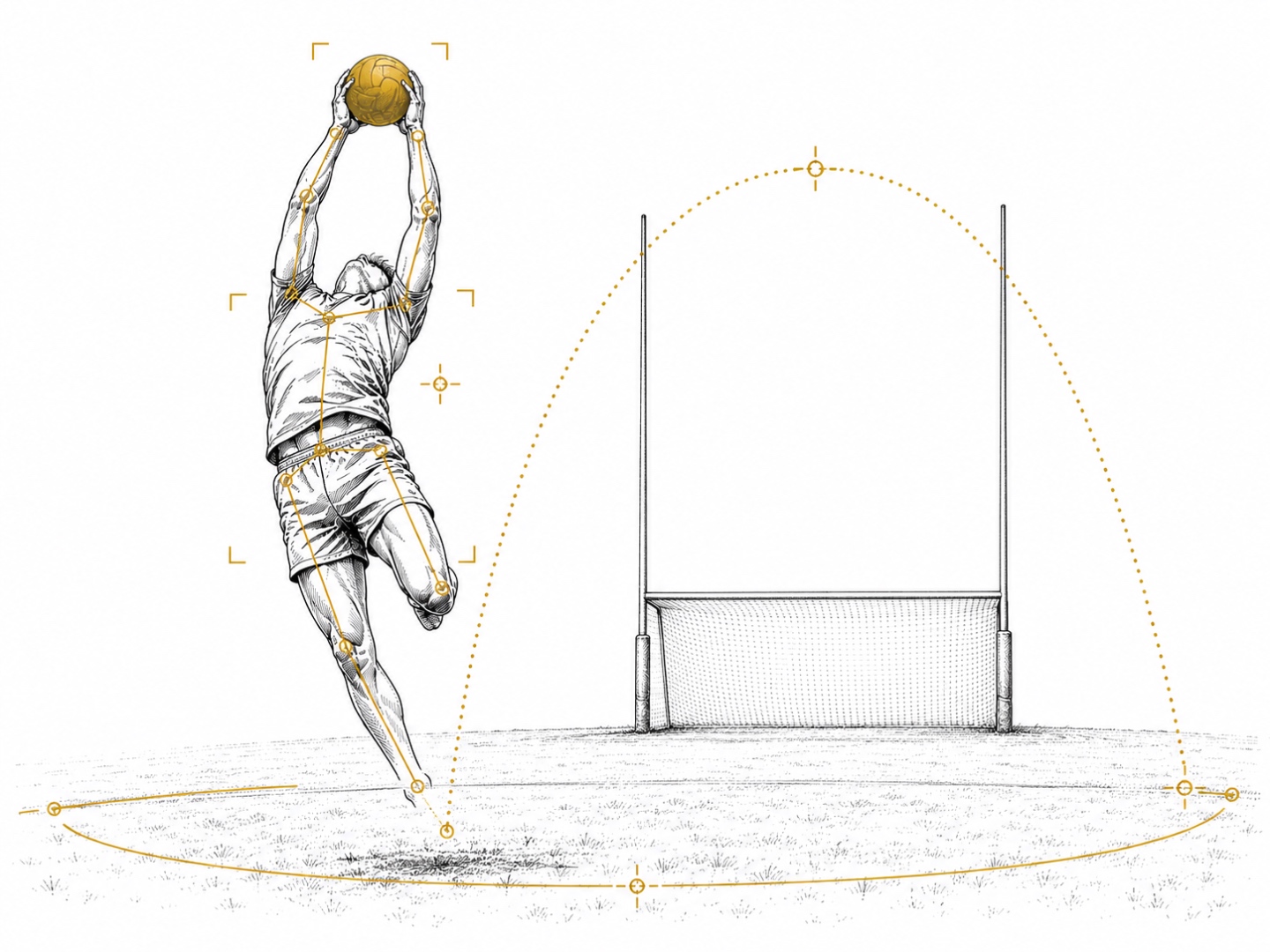
No phrase in Gaelic football generated more heat in 2025 than the mark. Pundits relitigated it weekly; players were split; supporters could agree only that everyone else was wrong about it. So we did the unglamorous thing and asked how often the disputed event actually occurred. The answer, from the game's own analysts, is twenty‑five times, across a season of 214 inter‑county matches. The most‑argued rule in the sport is also one of its rarest.
That single fact reframes the debate, but only once you separate two things the word mark has quietly fused together. There is no such thing as "the mark." There are two of them, and in 2025 they pulled in opposite directions.
What happened
Two rules wearing one name
The mark entered the game in 2017 to reward a clean catch from a kick‑out; an attacking version followed in 2020. Under the enhanced rulebook trialled in 2025, the season that produced these numbers, the two settled into distinct jobs, governing entirely different parts of the field.
Rule 01, Midfield
The kick‑out mark
A clean catch of a kick‑out on or beyond your own 45. It lives in the middle third, where the aerial contest is decided.
Status: structurally central
Rule 02, Attack
The advanced mark
A clean catch inside the opposition 20‑metre line, from a kick beyond the 45. Its catching zone shrank to a strip the depth of the small square.
Status: near‑extinct
Treat them as one number and you learn nothing. Separate them and the season tells a clear story: one nearly vanished, while the territory the other governs took over the game. Start with the one everyone pictures, the high catch in front of goal.
The number
A rule you could miss for a month
Below, every inter‑county game of the 2025 season is a single square, all 214 of them. The gold squares are the games that produced an advanced mark. The picture is the argument: you can scan almost the whole season before you find one.
Scarcity · every inter‑county game, 2025
Find the mark
That is the attacking mark, the celebrated catch, the one in the debate. It surfaced in roughly one game in nine. To call it a feature of the modern game is to mistake a footnote for a chapter.
The mark you argue about happens once a fortnight of football. The mark you don't think to name now shapes nearly every restart.
The other half
Where the catch actually came back
Here is the half the debate skips. The kick‑out mark rewards winning the ball cleanly in the air, and in 2025 that contest stopped being a sideshow. The new rules forced kick‑outs long, banned the goalkeeper as a release valve, and priced interference with the restart. The single clearest fingerprint is where the ball now lands. For a decade the kick‑out was a short pass to a corner‑back. In 2025 it became a long ball into the middle third, straight into the zone the kick‑out mark governs.
The restart · where kick‑outs land, by pitch zone
The kick‑out moved up the field
Share of kick‑outs landing in each third of the pitch, measured from the kicker's own goal. Same metric, two seasons, the safe short ball gave way to the long contest.
That shift is the whole story of the kick‑out mark. The rule barely changed; its habitat was rebuilt around it. The clean catch in the middle third, once a quaint relic of a more direct era, is again one of the most valuable acts in the game, and the kick‑out mark is the rule that puts a price on it.
Context
Everything got louder except the mark
Step back and the scale of the 2025 reset is its own argument. Almost every measurable thing about football changed, and changed loudly. Against that backdrop, the advanced mark is the one number that barely moved off zero. Every figure here is counted from games, not from opinion.
The 2025 reset · measured change on prior seasons
One season, measured six ways
What it means
The argument was about the wrong half
The mark didn't fail and it didn't succeed. It split. One version withered to a rounding error, twenty‑five events in a season of thousands. The other quietly became the gatekeeper of the game's most important contest, as the kick‑out it rewards was pushed thirty metres up the pitch into a live aerial duel. A year of debate treated them as one thing and argued, mostly, about the half that barely happens.
This is the gap between reporting football and understanding it. The talking point was the noise. The count, twenty‑five, against a kick‑out that moved up the field in nearly every game, is the signal. They point in opposite directions, and only one of them decides matches.